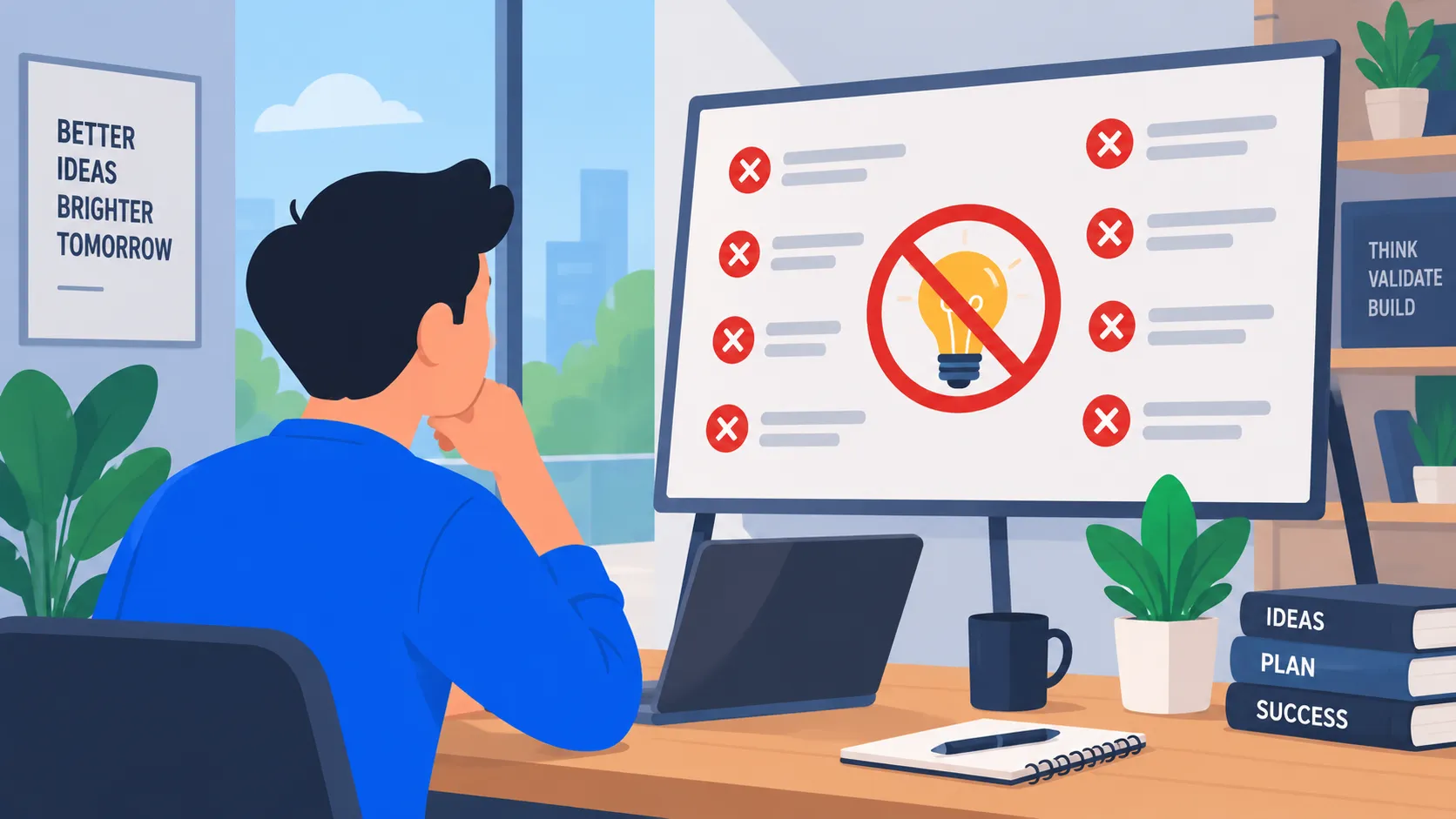
A Bad Business Idea Can Still Sound Exciting
Many weak business ideas sound impressive in conversation. They may involve a growing technology, a large market, an elegant product, or a problem that almost everyone recognizes. None of those qualities guarantee that customers will buy. Businesses depend on behavior. Customers need to care enough about the problem, prefer the proposed solution enough to change what they already do, and create enough economic value for the company to survive.
The Goal Is Not to Eliminate Risk
No amount of research can prove that a startup will succeed. Even businesses with strong demand, paying customers, and experienced founders can fail. Early validation has a narrower purpose: identify whether the evidence is strong enough to justify the next investment. When several major warning signs appear together, continuing to build without resolving them turns uncertainty into unnecessary risk.
Sign 1: Customers Do Not Care Enough About the Problem
The first warning sign is simple but often ignored. The problem exists, yet customers do not care enough to change their behavior. They may agree that the situation is inconvenient, describe the idea as useful, and even say they would try a solution. But when the problem occurs, they tolerate it and continue with their day. A business struggles when the founder feels more urgency about solving the problem than the customer does.
A Problem Is Not Automatically a Market
Almost every person experiences hundreds of small frustrations. Most never become businesses because solving them is not important enough to justify time, money, or behavioral change. The existence of pain is therefore only the beginning of validation. The important question is what customers do because of that pain.
Look at Customer Behavior
Strong problems tend to create visible behavior. Customers search for solutions, ask for recommendations, build workarounds, complain repeatedly, pay for alternatives, hire people, or switch providers. Weak problems produce much less action. If extensive research finds discussion but almost no effort to solve the issue, the market may not care enough.
Frequency Can Reveal Weakness
A problem that happens rarely can be difficult to monetize unless the consequences are significant. If customers encounter the issue once every few years and the outcome is minor, they may never prioritize a specialized solution. Frequency should be considered alongside severity rather than used as a rule, but low-frequency, low-severity pain is a serious warning sign.
Severity Matters Too
Some problems occur constantly but remain trivial. A customer may complain about an extra click in a workflow every day without ever paying to remove it. Ask what the problem costs in time, money, risk, revenue, convenience, or emotional value. If the consequence is negligible, the business may be solving something customers simply do not value enough.
Customers Should Not Need to Be Taught to Feel the Pain
New categories sometimes require education, but there is a difference between explaining a new solution and convincing customers that their existing situation is unacceptable. If every sales conversation begins by persuading people that they have a problem they have never noticed, acquisition can become expensive. Stronger opportunities often begin where customers already recognize the pain.
Sign 2: People Like the Idea but Will Not Pay
Positive feedback can be dangerously comforting. Friends, online communities, survey respondents, and potential users may genuinely like an idea while having no intention of purchasing it. Compliments are cheap. Payment requires a customer to give something up. When enthusiasm disappears as soon as price enters the conversation, the commercial opportunity may be much weaker than it appeared.
Do Not Confuse Interest With Willingness to Pay
Likes, comments, waitlist signups, survey responses, and free users can all be useful signals, but they measure different things from payment. A person can join a waitlist because the concept sounds interesting. A paying customer has decided that the expected value exceeds the cost. That difference is fundamental.
Look for Existing Spending
Before building, investigate whether customers already spend money around the problem. They may purchase competing software, hire agencies, employ staff, pay freelancers, or subscribe to several tools. Existing spending demonstrates that the outcome receives budget. If customers consistently rely on free solutions and resist every paid alternative, monetization deserves much more scrutiny.
Listen to Price Conversations
Customers calling a product expensive does not automatically indicate weak willingness to pay. Some complain and continue renewing because the product remains valuable. The more important behavior is whether they cancel, downgrade, seek alternatives, or refuse to buy. Price should be interpreted through action rather than sentiment alone.
Test a Real Price
Eventually, the only way to understand willingness to pay for your specific offer is to expose customers to a credible price. A landing page with no price can overstate demand because visitors imagine whatever cost feels acceptable to them. A paid pilot, preorder, deposit, or actual purchase creates stronger evidence because the decision becomes real.
Sign 3: Customers Already Have a Good Enough Free Alternative
Free alternatives can destroy an otherwise attractive paid opportunity. The alternative does not need to be perfect. It only needs to solve the problem well enough that customers do not feel motivated to switch. Spreadsheets, templates, open-source software, free plans, manual processes, and general-purpose AI tools can all become powerful competitors.
Good Enough Is More Dangerous Than Perfect
Founders often compare a proposed product with an alternative and identify dozens of ways their solution could be better. Customers do not necessarily care. If the current option is familiar, free, and adequate, incremental improvements may not overcome the friction of changing. The real competitor is the customer’s satisfaction threshold.
Research Why Customers Stay Free
Do customers use a free solution because nothing better exists, or because the problem is not worth paying for? These situations look similar but imply very different opportunities. If users repeatedly outgrow the free option and search for paid alternatives, demand may exist. If they remain satisfied indefinitely, a paid entrant faces a difficult market.
AI Has Made This Question More Important
General-purpose AI can now perform tasks that once required specialized software. A startup whose entire value proposition can be reproduced easily with a generic AI assistant may struggle to justify another subscription. Specialized workflow, proprietary context, reliability, integrations, collaboration, automation, or another meaningful advantage may be necessary to create paid value.
Sign 4: Customers Complain but Never Switch
A market full of complaints can look like an obvious startup opportunity. Sometimes it is. Other times customers complain because every available solution involves trade-offs they are willing to tolerate. If users criticize a competitor repeatedly but continue paying year after year, the dissatisfaction may not be strong enough to create an opening.
Complaints Are Discovery Evidence
Negative reviews and frustrated discussions are excellent places to discover possible pain points. They reveal expectations that existing products fail to meet. However, a complaint should begin an investigation rather than end it. The next question is what the customer does afterward.
Switching Intent Is Stronger
Customers comparing alternatives, exporting data, cancelling subscriptions, requesting migration advice, or testing replacements provide stronger evidence. These actions demonstrate that dissatisfaction has crossed a behavioral threshold. If you cannot find meaningful switching intent despite abundant complaints, the market may be more loyal to incumbents than it appears.
Switching Costs Can Protect Bad Products
Customers can remain with products they dislike because moving is difficult. Data, integrations, training, contracts, workflows, and organizational habits create switching costs. A new product must deliver enough additional value to overcome those costs. Being slightly better may not be sufficient.
Sign 5: Your Only Differentiation Is a Feature Competitors Can Copy Quickly
A new feature can attract attention without creating a durable business. If established competitors can reproduce the core advantage in a few weeks and distribute it to an existing customer base, the opportunity may disappear quickly. This is especially relevant in software markets where technical capabilities become widely available.
Features Are Not Always Moats
Customers buy products for many reasons beyond features. Distribution, brand, reliability, data, integrations, community, service, network effects, and specialized workflows can create stronger advantages. A startup relying entirely on one visible feature should ask what happens if every major competitor launches something similar.
AI Alone Is Rarely Enough Differentiation
Adding AI to an existing category can create a better product, but access to common AI models is available to many companies. The important question is what the AI enables that customers value and competitors cannot easily reproduce. A specialized workflow, unique data, superior research process, deep integrations, or better distribution may matter more than simply describing the product as AI-powered.
Ask Why the Product Needs to Exist Separately
If customers can obtain nearly the same result by using an existing platform, plugin, or general-purpose tool, a standalone product needs a clear reason to exist. Convenience can be enough when it is substantial, but the difference should affect customer behavior rather than merely make the founder’s product technically distinct.
Sign 6: The Market Has Competition but No Clear Reason to Switch
Competition proves that customers may spend money, but it does not prove they want another provider. A crowded market can support many businesses when customers have diverse needs. It becomes less attractive when established products are strong, satisfaction is high, and the proposed startup offers only superficial differences.
Research Competitor Strengths
Founders naturally search for weaknesses because weaknesses create opportunity. Start by understanding why incumbents succeed. They may have excellent products, strong brands, deep integrations, powerful distribution, large communities, or years of customer trust. A realistic strategy must account for these strengths.
Do Not Mistake Different for Better
A new interface, pricing model, technology, or set of features may make a product different without making it more valuable. Customers switch when the difference solves something they care about enough to justify change. Validation should test whether the proposed advantage changes purchasing behavior.
Look for a Clear Wedge
A credible entry point often serves a specific customer segment or workflow better than broad incumbents do. The wedge might involve specialization, simplicity, a painful integration, a neglected audience, a different business model, or a substantially better outcome. If you cannot explain why a particular customer should choose the new product now, the competitive case remains weak.
Sign 7: Customer Acquisition Looks More Expensive Than the Customer Is Worth
A real problem and good product can still produce a bad business if customers are too expensive to acquire. Distribution is not something to solve after development. Before building, research where customers discover solutions, how competitors reach them, how much sales effort may be required, and whether expected revenue can support that acquisition process.
A Market Can Be Real but Hard to Reach
Some customer groups are fragmented across many channels, rarely search for solutions, and require extensive education. Others gather in identifiable communities, marketplaces, search queries, or professional networks. The easier it is to reach customers when they experience the problem, the more favorable the opportunity can become.
Low Prices Limit Acquisition Options
A product generating a small amount of revenue per customer usually cannot support an expensive sales process. If the market requires demos, personalized onboarding, long negotiations, and significant support while customers will only pay a small subscription, the economics may become difficult. This mismatch should be discovered before scaling.
Distribution Advantage Can Matter More Than Product Advantage
A slightly better product with no efficient path to customers can lose to an average product with excellent distribution. Search demand, communities, partnerships, marketplaces, existing audiences, integrations, and direct access to buyers can all create advantages. If your plan for customer acquisition is simply “run ads,” more research is needed.
Sign 8: The Economics Do Not Work
Revenue alone does not make a business viable. The cost of delivering the product, supporting customers, acquiring users, processing transactions, running infrastructure, fulfilling orders, and handling returns or service can consume the value created. An idea can generate purchases while still losing money in a way that becomes worse as it grows.
Estimate the Economics Early
Early estimates will be imperfect, but obvious structural problems can still be identified. Consider expected price, gross margin, acquisition cost, support requirements, delivery costs, and how long customers are likely to remain. The goal is not a precise financial forecast. It is determining whether a plausible path to sustainable economics exists.
Beware of Human Labor Hidden Inside Software
Some software products appear highly scalable while relying on substantial manual work behind the scenes. Customer onboarding, data cleanup, quality control, support, research, content review, or custom implementation can create hidden costs. Manual processes can be useful during validation, but the long-term model should account for what can realistically be automated.
Usage Costs Matter for AI Products
AI products can incur variable inference, search, storage, and processing costs each time customers use them. Low pricing combined with heavy usage can create weak margins. Founders should understand how cost changes with customer behavior and whether pricing aligns with the value and resources consumed.
Sign 9: The Idea Depends on Too Many Unproven Assumptions at Once
Every startup begins with uncertainty, but some ideas require several unlikely things to become true simultaneously. Customers must adopt a new behavior, pay an unfamiliar price, trust a new technology, abandon an entrenched product, and arrive through an untested distribution channel. Each assumption adds risk.
Identify the Critical Assumptions
Write down what must be true for the business to work. The customer must experience the problem, care enough to solve it, accept the product, pay enough, be reachable economically, and continue receiving value. Industry-specific businesses may add regulatory, technical, supply, marketplace, or operational assumptions.
Test the Most Dangerous Assumption First
Founders often test what is easiest rather than what could kill the business. Building a prototype can feel productive even when the largest uncertainty is whether anyone will pay. If one assumption would make the entire opportunity unattractive if false, investigate it before polishing everything else.
Reduce Uncertainty Sequentially
A strong validation process moves from cheap questions toward expensive commitments. Research can test whether the problem and market exist. Interviews can clarify behavior. A prototype can test usability. A paid offer can test willingness to pay. Real usage can test retention. Each stage should earn the right to spend more.
Sign 10: Research Keeps Contradicting the Story You Want to Believe
The most dangerous warning sign can be the founder’s reaction to evidence. If every negative finding is dismissed while every positive comment is celebrated, validation has become confirmation. A business idea should be allowed to fail the research process. Otherwise research becomes decoration rather than decision support.
Confirmation Bias Can Make Weak Ideas Feel Strong
Once people invest identity, time, or money into an idea, they naturally search for reasons to continue. A founder may interpret competitors as proof of demand, complaints as proof of opportunity, a large market as proof of scale, and positive survey responses as proof of willingness to pay. Each statement can contain some truth while still avoiding the central question of whether the combined evidence supports the business.
Search Deliberately for Counter-Evidence
Ask what would make you decide not to build. Then search for it. Investigate satisfied competitor customers, strong free alternatives, failed startups, weak switching behavior, low willingness to pay, difficult distribution, and structural costs. A business idea that remains attractive after serious counter-research is more credible than one protected from criticism.
Trust Strong Behavior Over Weak Opinions
When evidence conflicts, give more weight to behavior that requires commitment. Actual spending is stronger than hypothetical willingness to pay. Repeated switching is stronger than complaints. Costly workarounds are stronger than casual interest. Retention is stronger than initial curiosity. This hierarchy helps prevent loud but weak signals from controlling the decision.
One Warning Sign Does Not Always Kill an Idea
Markets contain trade-offs. A product may face strong competition while also serving a clearly underserved segment. A customer problem may occur infrequently but create enormous economic consequences. Free alternatives may exist while professional users happily pay for reliability and automation. The purpose of these warning signs is not to create rigid rules but to identify risks that need credible answers.
Several Warning Signs Together Matter More
A weak problem, low willingness to pay, strong free alternatives, high switching costs, and expensive acquisition reinforce one another. When several major risks point in the same direction, the burden of proof should increase. Continuing because one encouraging signal exists can become an expensive form of optimism.
Competition Alone Is Not a Reason to Stop
A market with competitors can be attractive because demand and spending already exist. The key is whether customers remain underserved in a way that matters. Research customer complaints, switching behavior, pricing, segmentation, and competitor strengths before deciding that the category is too crowded.
A Small Market Alone Is Not a Reason to Stop
A focused niche can support a profitable business when customers have strong pain, meaningful budgets, and efficient distribution. Market size should be evaluated relative to the type of company you want to build. A niche that is too small for a venture-scale outcome can still support an excellent independent business.
A Difficult Product Alone Is Not a Reason to Stop
Technical difficulty can create defensibility when the problem is valuable enough. The danger appears when expensive development is combined with uncertain demand. Strong customer evidence can justify tackling hard technical problems, while weak demand makes complexity much more dangerous.
Negative Feedback Alone Is Not a Reason to Stop
Customers may dislike an early implementation while strongly wanting the underlying outcome. Product feedback and market demand answer different questions. A bad prototype can be improved. A market that does not care is much harder to fix. Determine whether negative feedback concerns execution or the value proposition itself.
Use Research Before Making the Build Decision
The best time to discover these warning signs is before large commitments are made. Search customer discussions, competitor websites, reviews, pricing pages, marketplaces, alternative requests, and public evidence of buying behavior. The objective is to understand how the market behaves before assuming that a product will change it.
Use Foundly to Search for Reasons Not to Build
Foundly can help founders investigate an idea across demand, customer pain, buying intent, competition, pricing, complaints, risks, and potential opportunities. One of the most useful ways to approach this research is to search deliberately for evidence that could weaken the idea. A research process becomes more valuable when it can say that a version of an idea should not be built rather than automatically finding reasons to support it.
Use Foundly to Compare Positive and Negative Signals
A useful conclusion should emerge from the evidence as a whole. Foundly can help organize market signals, but the important question remains what those signals mean commercially. Strong demand combined with weak switching intent tells a different story from strong demand combined with recurring alternative requests. The evidence should determine the verdict rather than the founder’s preferred answer.
Do Not Use Foundly as an AI Fortune Teller
No research tool can predict startup success with certainty. Foundly is better understood as a way to investigate the market before committing resources. It can accelerate discovery and synthesis, but customers ultimately validate the product through behavior. The purpose is to make a better decision under uncertainty, not eliminate uncertainty.
Look for Evidence That Customers Already Act
A business opportunity becomes stronger when customers are already doing something about the problem. They search, spend, compare, switch, complain, hire, automate, or build workarounds. Existing behavior demonstrates that the problem has consequences. An idea that requires customers to develop entirely new motivation deserves more skepticism.
Look for Evidence of Existing Budgets
Money already allocated to the problem provides useful context for monetization. Customers may pay direct competitors or spend indirectly through labor and services. Existing budgets do not guarantee your product will win, but they show that the desired outcome has economic value.
Look for Evidence of Urgency
Urgency can separate important problems from indefinitely postponed ones. Deadlines, revenue loss, compliance requirements, operational failures, customer complaints, and growth can create moments when buyers actively seek solutions. If the problem never becomes urgent, conversion may depend on unusually strong marketing.
Look for Evidence of Switching
A startup entering an existing market needs customers to change behavior. Search for people leaving products, seeking alternatives, or expressing clear reasons to move. If everyone acknowledges competitor weaknesses but remains satisfied enough to stay, the opportunity may require a stronger wedge.
Look for Evidence of Retention Potential
A purchase validates initial willingness to pay. A sustainable business often needs continued value. Research whether the problem recurs, whether workflows become embedded, and whether customers have ongoing reasons to use the solution. A one-time problem can still support a business, but the monetization model should match the usage pattern.
Understand Why Customers Say No
Rejection contains useful information when it comes from the target customer. A buyer may reject the product because the problem is not urgent, the price is too high, switching is difficult, the solution lacks trust, or another alternative works well. Different objections require different responses. Repeated “no” for the same fundamental reason can become a powerful warning sign.
Do Not Solve Every Rejection With Another Feature
When customers reject a product, founders often respond by adding functionality. This can create complexity without addressing the actual reason people do not buy. If the problem is weak demand, poor positioning, high switching costs, or low willingness to pay, more features may make the business worse rather than better.
Know When to Narrow the Idea
A broad idea may look weak while a specific segment shows strong evidence. Perhaps general project-management software is saturated, but a particular professional workflow remains painful. Narrowing can create clearer positioning, easier distribution, and stronger product-market fit. The decision should be supported by segment-specific evidence.
Know When to Change the Problem
Research may reveal that the original problem is minor while an adjacent problem generates repeated pain and spending. This is a valuable outcome. The purpose of validation is not to preserve the original idea. It is to find an opportunity worth pursuing.
Know When to Change the Customer
The same solution can create different value for different audiences. Consumers may expect a tool free while professionals pay because it saves billable time. Small businesses may find a product expensive while enterprises consider it inexpensive. Researching adjacent customer segments can reveal stronger economics.
Know When to Change the Business Model
Customers may value the outcome but reject the proposed way of paying. A subscription may be inappropriate for infrequent usage, while transaction, service, usage-based, or one-time pricing may fit better. Business-model changes should reflect customer behavior rather than simply disguise weak willingness to pay.
Know When to Walk Away
Walking away becomes rational when the central assumptions remain weak after serious investigation. If customers do not care enough, refuse to pay, prefer free alternatives, rarely switch, are expensive to acquire, and provide little evidence of recurring value, continued development may not be justified. The founder can redirect time toward an opportunity with stronger signals.
Stopping Can Be a Successful Validation Result
Validation is often presented as a process for proving an idea is good. That framing creates pressure to continue. A more useful definition treats a clear “do not build” conclusion as valuable. Avoiding months of development, advertising, or inventory investment can create more economic value than forcing a weak product into the market.
Do Not Fall for Sunk Costs
Money and time already spent cannot make future investment more rational. If new evidence weakens the business case, evaluate the next decision based on what is known now. Continuing only because substantial effort has already been invested compounds the original mistake.
Do Not Let Identity Become Attached to One Idea
Founders can become emotionally tied to being the person who builds a particular product. This makes changing direction feel like failure. A stronger identity is being someone who finds and solves valuable problems. Ideas are hypotheses. They should be replaceable when the evidence improves.
Do Not Let a Domain Name Become a Strategy
Buying a memorable domain, creating branding, or designing a polished landing page can create psychological commitment without improving the underlying market. These assets may be useful later, but they should not influence whether the business deserves to exist. Customer behavior remains more important than presentation.
Do Not Let Development Progress Become Validation
A working product proves that the product can be built. It does not prove that customers want it. Technical progress and market validation are separate. A founder can ship quickly and still move efficiently in the wrong direction.
Do Not Let a Large Market Size Replace Evidence
A trillion-dollar industry can contain thousands of unattractive niches. Market size does not prove that your target customer experiences the problem, wants your solution, or can be acquired profitably. Bottom-up evidence about specific customers often matters more at the beginning than impressive top-down statistics.
Do Not Let Trend Growth Replace Evidence
A fast-growing technology or category can create genuine opportunities, but growth alone does not validate a particular product. Hundreds of companies can enter a trend while customers consolidate around only a few. Research the specific problem, customer, competition, and buying behavior rather than assuming the trend will carry every participant.
Do Not Let Investor Interest Replace Customer Interest
Investors can become excited about markets, technologies, and teams for reasons different from customers. Funding may extend the amount of time available to find product-market fit, but it does not create customer demand. A business ultimately needs people or organizations that value what it provides.
Do Not Let Friends Validate the Idea
Friends and family usually want to encourage the founder. Their positive reactions are emotionally useful but commercially weak unless they are genuine target customers making realistic commitments. Validation should come from people whose behavior resembles the future market.
Do Not Let Surveys Become the Final Answer
Surveys can identify preferences and patterns, but hypothetical answers should not outweigh actual behavior. Respondents can overstate interest, underestimate price sensitivity, and answer in ways that sound socially desirable. Use surveys to generate hypotheses and stronger tests to evaluate them.
Do Not Let a Waitlist Become the Final Answer
A waitlist can demonstrate interest, especially when people discover it through realistic channels. It does not prove willingness to pay or retention. The next step is to move subscribers toward meaningful behavior such as a conversation, trial, pilot, preorder, or purchase.
Do Not Let Free Users Become the Final Answer
Free usage demonstrates that customers may value a product when price is removed. The business question is whether enough value remains when payment is required. If monetization is essential to the model, introduce it early enough to learn before scale creates misleading confidence.
Use Small Experiments to Resolve Warning Signs
A warning sign does not always require abandoning the idea immediately. It may identify the next experiment. Weak willingness to pay can be tested with a real offer. Uncertain switching intent can be investigated through interviews with competitor customers. Distribution uncertainty can be tested through a small acquisition campaign. The key is making the experiment directly address the risk.
Make the Next Test Cheaper Than the Next Build
When uncertainty is high, information is often more valuable than additional product development. A simple landing page, customer conversation, manual service, prototype, or paid pilot may answer a critical question faster than another month of coding. Validation should reduce uncertainty before increasing commitment.
Demand Evidence Before Major Spending
The more expensive or irreversible the next step becomes, the stronger the evidence should be. Ordering inventory, hiring employees, signing leases, or investing heavily in development deserves more validation than creating a weekend prototype. Risk should determine the amount of evidence required.
What a Business Idea Worth Building Often Looks Like
Stronger ideas tend to show convergence across several forms of evidence. A specific customer experiences meaningful pain, takes action to solve it, spends money or valuable time, remains dissatisfied with existing alternatives, can be reached through plausible channels, and responds to a credible offer. No single signal guarantees success, but together they make the next experiment more rational.
What a Business Idea Not Worth Building Often Looks Like
Weak ideas often depend on enthusiasm rather than behavior. Customers agree the product sounds useful but do little about the problem. Free alternatives work well, competitors have satisfied users, switching is difficult, payment intent is weak, distribution is unclear, and the economics require unrealistic assumptions. When this pattern persists after careful research, building more usually does not solve the underlying problem.
The Evidence Can Point to “Not This Version”
Sometimes the correct conclusion is not to abandon the entire market but to reject the current version of the idea. Research may reveal a stronger niche, different buyer, more urgent problem, better business model, or underserved workflow. A decisive “do not build this version” can become the beginning of a much stronger opportunity.
Research Can Reveal What to Build Instead
When a weak idea is investigated properly, adjacent opportunities often appear. Competitor complaints can reveal underserved segments. Workarounds can reveal missing workflows. Pricing frustration can reveal packaging gaps. Alternative requests can expose switching triggers. The research process can therefore create value even when the original concept fails.
Final Thoughts on Signs Your Business Idea Is Not Worth Building
A business idea is not worth building simply because it is creative, technically possible, or exciting. Watch for customers who do not care enough about the problem, weak willingness to pay, strong free alternatives, complaints without switching, copyable differentiation, no clear competitive wedge, difficult acquisition economics, structural cost problems, too many unproven assumptions, and research that repeatedly contradicts the story you want to believe. Foundly can help founders investigate these signals across demand, customer pain, buying intent, competition, pricing, risks, and market opportunities before major resources are committed. The objective is not to become pessimistic about every idea. It is to make sure the ideas that receive your time and money have earned that investment through evidence.