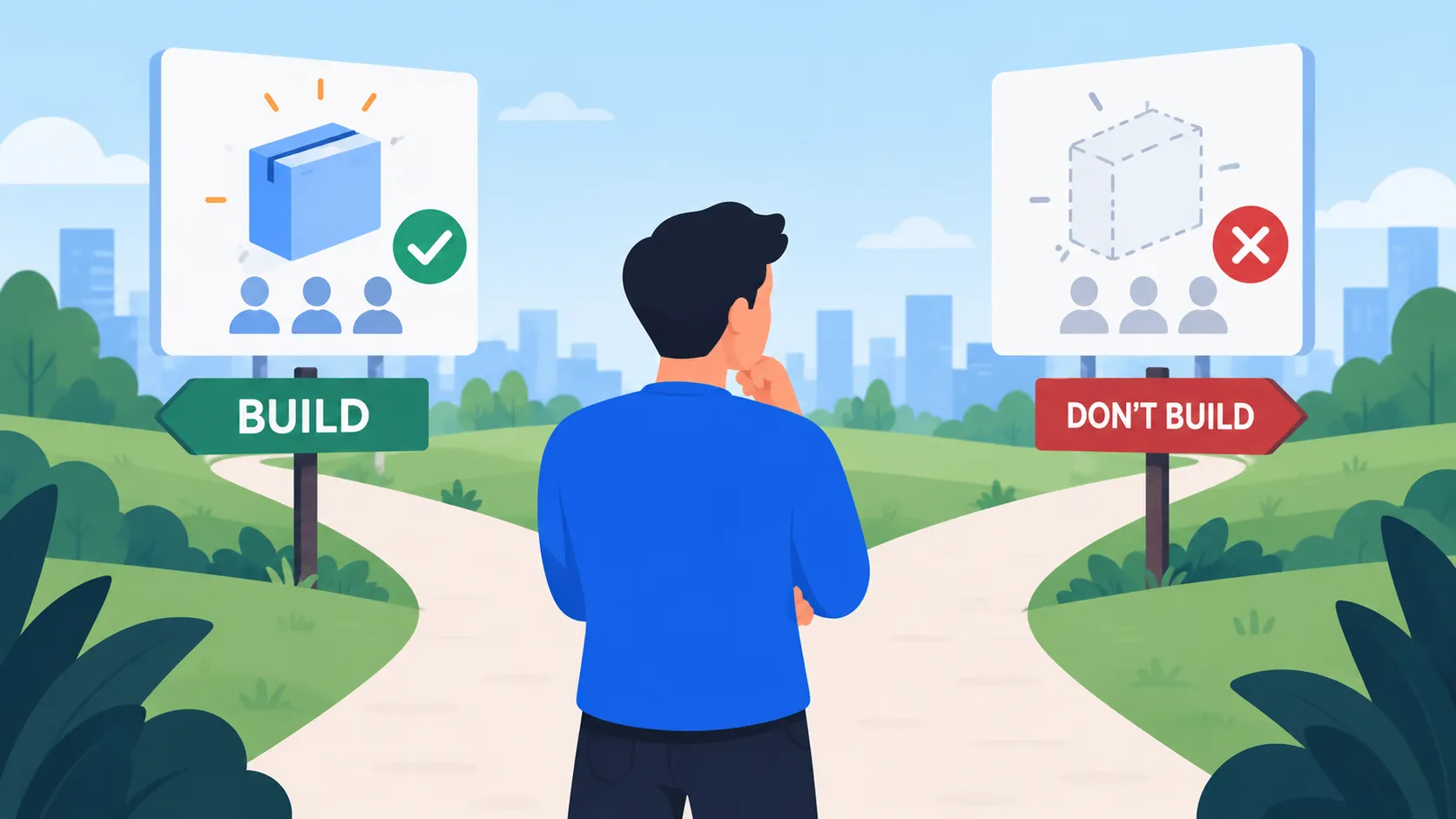
What Makes a Startup Idea Worth Building?
A startup idea is worth building when the opportunity behind it is strong enough to justify the risks required to test it. That usually means a recognizable customer experiences a meaningful problem, the problem creates enough motivation to seek a solution, customers demonstrate some form of demand or spending, existing alternatives leave room for improvement, and the startup has a realistic way to reach those customers. No single factor guarantees success. The decision becomes stronger when several independent market signals point toward the same conclusion.
A Good Idea Is Not the Same as a Good Business
Many ideas are genuinely useful but still make weak businesses. A product can save people a few minutes, entertain them, or solve a small inconvenience without creating enough value for customers to pay. A business needs more than usefulness. It needs customers who care enough about the outcome, a practical way to deliver that outcome, a viable way to acquire customers, and economics that can eventually support the company. Evaluating a startup idea therefore requires looking beyond whether the product would be nice to have and asking whether the underlying opportunity can support a sustainable business.
Start With the Problem, Not the Product
Founders often become attached to a solution before understanding the problem deeply enough. They imagine an application, feature set, or technology and then search for people who might want it. A stronger approach begins with the customer problem. What happens today? How frequently does it happen? Why is it frustrating? What does it cost in time, money, lost revenue, stress, or missed opportunities? What does the customer currently do about it? If the problem is weak, improving the proposed product rarely fixes the underlying opportunity.
Ask Whether the Problem Happens Frequently Enough
Frequency matters because recurring problems naturally create more opportunities for a product to deliver value. A task that wastes thirty minutes every day may create stronger demand than a larger inconvenience that happens once every few years. Frequency also affects retention. Software designed around a workflow customers perform every week may become part of their routine, while a product solving an occasional problem may struggle to bring users back. This does not mean infrequent problems cannot support businesses, but the value created each time may need to be significantly higher.
Measure How Painful the Problem Really Is
Customers complain about thousands of things they will never pay to fix. The existence of frustration alone does not make a startup worth building. The more useful question is what the problem causes. Does it waste expensive employee time? Does it create lost sales? Does it make customers abandon purchases? Does it expose a business to risk? Does it prevent someone from completing an important task? Problems connected to measurable consequences tend to produce stronger commercial opportunities because solving them creates clearer value.
Look at What Customers Do Today
Current behavior is one of the most informative forms of startup research. If people experience the problem, they are probably doing something about it already. They might use a competitor, spreadsheet, employee, agency, freelancer, template, general-purpose tool, manual workflow, or complicated combination of products. They may also choose to tolerate the problem. Understanding the current alternative reveals the standard your startup must beat. If customers already have a simple, free, and satisfactory solution, convincing them to change may be much harder than the original idea suggests.
Search for Evidence of Existing Demand
A startup becomes more interesting when people independently demonstrate that they want the problem solved. Search for customers requesting recommendations, comparing products, discussing workarounds, asking how others handle the problem, searching for alternatives, and complaining about existing solutions. These signals are more meaningful when they appear repeatedly across independent sources. The objective is not to prove that people discuss the general topic. It is to determine whether customers actively behave as though solving the specific problem matters.
Do Not Confuse Attention With Demand
Attention can make a startup idea appear much stronger than it really is. A viral post, large online community, or popular trend can create enormous visibility without producing meaningful buying behavior. People can be fascinated by a topic while expecting every related product to be free. A smaller market where customers actively purchase solutions may be commercially stronger than a huge audience that mainly consumes free content. When evaluating a startup idea, behavioral signals should generally receive more weight than likes, views, comments, or general enthusiasm.
Look for Buying Intent
Buying intent is one of the clearest differences between an interesting idea and a potentially valuable business. Customers show buying intent when they take actions connected to spending or actively finding a solution. Someone asking for pricing, comparing paid alternatives, requesting a demo, searching for a replacement for a product they currently pay for, or hiring someone to perform the task manually is demonstrating more than curiosity. These behaviors suggest that the problem has economic importance and that a budget may already exist.
Existing Spending Is a Powerful Signal
One of the strongest reasons to investigate a startup idea further is discovering that customers already spend money solving the problem. The money does not need to go to a direct competitor. Businesses may pay employees, contractors, consultants, agencies, or several unrelated software products to accomplish the same outcome. Existing spending demonstrates that the problem has already crossed an important threshold: customers believe solving it is valuable enough to justify a financial cost. A new startup can then focus on whether it can deliver the outcome better, faster, more simply, or for a more specific audience.
Research the Competition Before You Build
Competitors can tell you a great deal about whether a startup idea deserves further investment. Their existence can prove that customers understand the category and already purchase solutions. Their websites reveal positioning, target audiences, features, and pricing. Their reviews reveal what customers value and dislike. Their history can reveal whether the category has remained commercially relevant over time. Competition should therefore be treated as market evidence rather than automatically interpreted as a reason to abandon an idea.
A Crowded Market Is Not Automatically a Bad Market
Some founders search for startup ideas with no competition because they believe originality creates an advantage. In reality, markets with established competitors can be attractive precisely because demand is already proven. The challenge is finding a reason to enter. If customers are satisfied, switching costs are high, and existing companies serve every important segment well, the opportunity may be weak. If customers repeatedly complain about the same problems, important niches are ignored, or existing products have become unnecessarily complex, a crowded category can still contain valuable openings.
No Competition Can Be a Warning Sign
A completely empty market can look exciting, but it deserves careful investigation. There may be no competitors because nobody has noticed the opportunity yet. There may also be no competitors because customers do not care enough, previous attempts failed, the economics are unattractive, or a simple substitute already solves the problem. When no direct competitors exist, research should focus heavily on customer behavior and indirect alternatives. The absence of companies does not prove the presence of opportunity.
Find Out Why Customers Choose Existing Solutions
Knowing that a competitor exists is less useful than understanding why customers select it. The answer may involve price, ease of use, integrations, brand trust, distribution, customer support, features, reliability, community, or simply familiarity. These strengths matter because a new startup may need to match them before its differentiation becomes relevant. A founder who focuses only on competitor weaknesses can underestimate how much customers value the things established products already do well.
Study What Customers Hate About Existing Products
Competitor complaints can reveal potential opportunities because the customers writing them have already demonstrated demand. They found a solution, adopted it, and often paid for it. Recurring frustration around complexity, pricing, missing integrations, unreliable features, poor customer support, limited customization, difficult onboarding, or products designed for the wrong customer segment can reveal gaps. The most valuable complaints are not isolated negative reviews but patterns that appear repeatedly across different customers and sources.
Ask Whether Complaints Actually Cause Switching
A customer can hate part of a product and still remain a loyal paying user. This is why complaints alone are not enough to justify a startup. Look for behavior connected to the complaint. Are customers actively requesting alternatives? Are they cancelling? Are they migrating to another product? Are they building workarounds because the existing solution cannot handle an important use case? Are they refusing to upgrade because of pricing? A complaint becomes commercially more interesting when it creates motivation to change.
Determine Whether Your Idea Has a Clear Wedge
A startup does not always need to beat every competitor for every customer. It often needs a strong initial wedge. That wedge might be a specific customer segment, workflow, distribution channel, pricing model, integration, or use case that larger competitors serve poorly. A broad idea such as another project-management platform may be difficult to justify. A focused product solving a painful approval workflow for a particular type of agency could be much easier to position and test. Narrowing the initial opportunity can turn a generic idea into something customers immediately understand.
Ask Why This Product Needs to Exist
A useful test is trying to explain why the startup deserves to exist without relying on vague statements such as “better user experience” or “powered by AI.” The answer should connect directly to customer value. Perhaps existing tools are built for enterprises while the target customer is a solo professional. Perhaps customers currently combine four products to complete one workflow. Perhaps an important process is still performed manually. Perhaps competitors charge for complexity a niche does not need. The clearer the reason for existence, the easier the idea becomes to evaluate and communicate.
Do Not Treat AI as Differentiation by Itself
Artificial intelligence can create powerful product capabilities, but simply adding AI does not automatically create a defensible startup. Customers generally care more about outcomes than the underlying technology. If several competitors can access similar models, the advantage may disappear quickly. A stronger AI startup idea connects the technology to a specific workflow, proprietary context, distribution advantage, specialized data, superior user experience, or measurable outcome. The question is not whether AI can be added but whether it creates enough customer value to change behavior.
Research the Market Before Writing Code
Founders frequently use development as a way to feel productive because building produces visible progress. Market research can feel less concrete, but it can prevent much larger mistakes. Before writing substantial code, investigate demand, customer pain, competition, buying intent, pricing, complaints, alternatives, and reasons the idea might fail. A few days of serious research can reveal that the initial concept needs a different audience or positioning before months of development make those changes painful.
Use Foundly to Investigate the Opportunity
Researching a startup idea manually can involve dozens of searches, competitor websites, customer discussions, review platforms, pricing pages, and notes that eventually need to be compared. Foundly can be useful when a founder wants to investigate an idea across signals such as market demand, customer pain, buying intent, competition, pricing, complaints, risks, and potential opportunities in a more focused research workflow. The important value is not simply receiving an AI opinion about an idea. It is using evidence to understand why the opportunity appears strong, weak, or worth changing.
Let Evidence Determine the Conclusion
A research tool should never become a machine for confirming what the founder already wants to believe. Whether Foundly is used or the research is performed manually, the process should begin with evidence and end with a conclusion. If customers show weak buying intent, strong satisfaction with free alternatives, or little motivation to switch, those findings should affect the decision even when the original idea feels exciting. If several independent sources reveal recurring pain, existing spending, active searches for alternatives, and an underserved segment, the evidence may justify moving forward.
Search for Reasons Not to Build the Startup
One of the strongest ways to evaluate a startup idea is deliberately trying to disprove it. Search for customers who are satisfied with current solutions, free products that solve the problem well, failed startups with similar concepts, high customer acquisition costs, regulatory barriers, difficult integrations, low-frequency usage, weak retention, and markets where users consistently resist paying. This creates a more balanced picture than research designed only to find positive signals. A startup idea that survives serious counter-research deserves more confidence.
Understand Confirmation Bias
Once a founder becomes emotionally attached to an idea, positive evidence becomes easier to notice and negative evidence becomes easier to dismiss. A favorable customer comment may feel important while ten signs of weak demand are rationalized away. Confirmation bias is particularly dangerous because it can make extensive research appear rigorous while producing a predetermined answer. The best defense is to define in advance what evidence would change your mind and actively search for it.
Evaluate the Strength of Free Alternatives
Free alternatives can dramatically change the economics of a startup. If customers can solve the problem effectively with a spreadsheet, existing platform, open-source tool, or general-purpose AI assistant, a paid product needs to create substantially more value. The presence of a free alternative does not make a startup impossible, but it raises the standard. Convenience, specialization, automation, reliability, collaboration, compliance, support, or measurable financial outcomes may provide enough value to justify payment. The research needs to determine whether customers actually care about those improvements.
Understand Switching Costs
Even when your product is objectively better, customers may not switch. Existing solutions contain data, workflows, integrations, habits, and organizational knowledge. Moving to a new product can require training, migration, approvals, and risk. Switching costs are especially important in business software where multiple employees depend on the same system. A startup idea becomes more attractive when the improvement is large enough to overcome these costs or when a natural trigger event makes customers ready to reconsider their current solution.
Find the Trigger That Creates Urgency
Customers do not experience the same level of buying intent at all times. A trigger event can suddenly make a previously tolerable problem urgent. A team grows beyond what its spreadsheet can handle. A vendor increases prices. A critical integration stops working. A company receives a compliance requirement. A freelancer gains enough clients that a manual process becomes impossible. Understanding these triggers helps determine when customers are most likely to search, switch, and pay. A startup with clear trigger events can often create more focused positioning and distribution.
Evaluate Whether the Customer Is Reachable
A startup idea can have genuine demand and still be difficult to build into a business if potential customers are expensive to find. Research where the target audience spends attention and how they discover new products. Search engines, online communities, marketplaces, newsletters, creators, conferences, professional associations, partnerships, outbound sales, and social platforms can all matter. A narrowly defined audience that gathers in predictable places may be easier to reach than a much larger audience scattered across the internet.
Think About Distribution Before Launch
Distribution should not be postponed until after the product exists. A founder should have at least a plausible explanation for how the first customers will discover the startup. This does not require a perfect long-term growth strategy, but it should go beyond “we will post on social media.” If customers actively search for solutions, SEO or paid search may work. If the audience belongs to specialized communities, partnerships or direct participation may work. If the product has high contract value, outbound sales may be viable. The business model and acquisition channel need to make sense together.
Evaluate Willingness to Pay
Willingness to pay cannot be established reliably by asking people whether they would hypothetically buy something. People are generous with imaginary money. Better evidence comes from what they already purchase, how much the problem currently costs them, and whether they take actions that require real commitment. Pricing conversations, deposits, preorders, paid pilots, and actual purchases provide stronger signals. The closer validation gets to a real transaction, the less the founder needs to rely on speculation.
Understand the Value Created
Pricing becomes easier to reason about when the value created is clear. A product that saves a business ten hours of expensive labor each month may have an obvious financial case. A tool that increases conversion rates, reduces churn, prevents errors, or helps close deals can potentially connect price to measurable outcomes. Consumer products may create emotional, entertainment, convenience, or status value instead. Whatever the category, the startup becomes more attractive when the customer can clearly understand why the outcome matters.
Check Whether the Business Economics Can Work
Early-stage financial projections are uncertain, but obvious economic problems can still be identified before building. Consider what customers might reasonably pay, how expensive the product will be to deliver, whether significant human labor is required, how often customers purchase, and what acquisition channels may cost. A product with strong demand can still become a weak business if service costs consume most revenue or acquiring customers costs far more than they are worth. The objective is not precise forecasting but identifying structural problems early.
Look for Repeat Usage or Repeat Value
Many successful software businesses become valuable because customers continue using them. Recurring usage creates opportunities for subscriptions, retention, and deeper integration into customer workflows. When evaluating an idea, consider whether the problem naturally repeats and whether the product remains valuable after the first use. A one-time need can still support a successful business, but the monetization and acquisition strategy may need to be different. Understanding usage frequency helps prevent forcing a subscription model onto a product customers only need occasionally.
Consider Retention Before You Have Retention Data
A pre-launch startup cannot know its future retention rate, but it can investigate whether the underlying workflow suggests recurring value. If customers perform the task every day or week and existing products have long-term users, recurring demand is plausible. If people only need the outcome once, retention may be naturally limited. Researching competitor reviews, usage patterns, customer routines, and the frequency of the problem can help form an early retention hypothesis that can later be tested with real users.
Talk to the People Who Actually Have the Problem
Direct conversations can expose assumptions that online research misses. The goal is not to pitch the startup and collect compliments. Ask potential customers about the last time they experienced the problem, what they did, what they tried, what they currently use, what they pay, and what would cause them to change. Past behavior is more useful than predictions. A customer explaining a painful manual process they perform every week provides stronger information than someone saying they might use a hypothetical product.
Do Not Ask Customers to Design the Startup for You
Customer research does not mean asking people which features you should build and implementing every request. Customers are excellent sources of information about their problems, behavior, frustrations, constraints, and desired outcomes. They are not always the best people to design the solution. A founder should identify patterns across customer evidence and determine which product approach can solve the underlying problem effectively. The purpose of interviews is understanding, not outsourcing product strategy.
Test the Riskiest Assumption First
Every startup idea contains multiple uncertainties, but one or two usually matter more than the others. Perhaps the biggest risk is whether customers will pay. Perhaps it is whether the technology can produce a reliable result. Perhaps the audience is difficult to reach. Perhaps a necessary integration is impossible. Identify the assumption that could kill the business and test it early. There is little value in validating secondary details while avoiding the question that determines whether the entire opportunity works.
Do Not Build Features to Avoid Testing Demand
Building more features can create the illusion that a startup is becoming more valuable while the fundamental demand question remains unanswered. If nobody is asking for the product, adding dashboards, integrations, settings, and animations does not solve the problem. Early development should be tied to learning. Each meaningful piece of the product should help test whether customers care, use it, return, or pay. The objective is not to make the product look complete before the market has responded.
Create the Smallest Test That Produces Useful Evidence
A startup does not always need a fully functional MVP to test interest. Depending on the idea, a founder might use a landing page, interactive prototype, manual concierge service, demo, paid pilot, preorder, or simple workflow powered behind the scenes by human effort. The test should be realistic enough that customer behavior means something. A fake button collecting meaningless clicks provides weak evidence, while a customer agreeing to spend time onboarding or paying for an early solution provides much stronger information.
Move From Opinions Toward Commitments
Validation becomes more reliable as potential customers make stronger commitments. Saying an idea sounds good costs nothing. Joining a waitlist costs a little attention. Booking a call requires time. Testing a product requires effort. Providing company data or changing a workflow requires trust. Paying requires money. Continuing to pay requires ongoing value. A founder should gradually move toward signals that resemble the behavior required by the eventual business rather than remaining comfortable with compliments and survey responses.
A Waitlist Is a Signal, Not a Verdict
Waitlists can help measure early interest, but their quality varies enormously. A thousand signups generated by a viral giveaway may be less valuable than fifty highly relevant potential customers who found the product while searching for a solution. The source of the signup, customer fit, subsequent engagement, and willingness to test all matter. A waitlist becomes more useful when it leads to stronger commitments rather than being treated as proof that the startup is already validated.
Preorders and Deposits Create Stronger Evidence
When appropriate for the business model, asking for money before the full product exists can provide powerful validation. A preorder or deposit forces the customer to make a real trade-off. The founder learns whether the promised outcome is valuable enough to justify payment rather than merely interest. This approach is not suitable for every startup, and expectations must be communicated clearly, but the general principle remains valuable: real commitments reveal more than hypothetical enthusiasm.
Know When the Evidence Is Strong Enough to Build
There is no universal threshold that makes a startup idea officially worth building. The required evidence depends on how expensive and risky the next step is. A founder capable of creating a software prototype in a weekend may reasonably move forward with less evidence than someone ordering physical inventory or hiring a large team. The decision should be proportional to the commitment. The more expensive it becomes to change direction, the stronger the evidence should be before making that commitment.
Look for Convergence Rather Than a Magic Score
Startup opportunities cannot be reduced reliably to an arbitrary score out of one hundred. A better approach is to look for independent signals that reinforce one another. Recurring customer pain, active solution searches, existing spending, competitor demand, repeated complaints, switching behavior, viable pricing, reachable customers, and early commitments become more persuasive when they all point in the same direction. Conflicting evidence should be investigated rather than averaged into a meaningless number.
What Strong Evidence Looks Like
Strong evidence is usually connected to behavior. Customers already paying for alternatives, dedicating employee time to the problem, requesting recommendations, searching for replacements, creating complicated workarounds, switching providers, accepting demos, joining pilots, placing deposits, purchasing, and returning to use a solution all indicate meaningful motivation. No individual signal guarantees success, but several strong behavioral signals can make an opportunity much more credible.
What Weak Evidence Looks Like
Weak evidence often feels emotionally rewarding because it arrives quickly. Friends praising the idea, social media likes, generic survey answers, huge market-size statistics, one enthusiastic online discussion, and AI-generated scores can all create excitement without demonstrating customer behavior. These signals are useful for generating hypotheses, but they should not carry the decision. A startup becomes safer to pursue when the evidence moves closer to what customers actually do with their time and money.
Do Not Let Market Size Distract You
Founders often begin with reports showing that an industry will be worth billions of dollars and then assume capturing a tiny percentage will create a large company. This approach says little about whether a specific customer will choose a specific product. A smaller market with severe pain, strong willingness to pay, clear distribution, and weak existing solutions can be more attractive than a massive category with intense competition and low switching intent. Market size matters, but it should be evaluated alongside customer reality.
Ask Whether the Timing Is Right
A good idea can arrive at the wrong time. New technologies, regulations, customer habits, infrastructure, economic conditions, and platform changes can make previously impossible products viable or make once-promising ideas obsolete. Research why the opportunity might work now rather than several years ago. If the answer involves a meaningful market shift, the startup may have a stronger reason to exist. If nothing has changed and many similar companies have failed, understanding why your outcome should be different becomes especially important.
Consider Founder Advantage
Market evidence matters most, but the founder’s ability to execute also affects whether an opportunity is worth pursuing. Relevant expertise, customer relationships, distribution access, technical capability, credibility, proprietary data, or deep understanding of the problem can create advantages. An opportunity that is difficult for a random founder may be highly attractive for someone with unusual access to the market. Founder advantage should not be used to excuse weak demand, but it can strengthen an otherwise promising opportunity.
Know When to Change the Idea
Research does not need to produce a simple yes or no. Sometimes the evidence supports the problem but not the proposed customer. Sometimes the customer is right but the solution is wrong. Sometimes competitors prove demand while their complaints reveal a narrower opportunity. A founder should remain flexible enough to change positioning, audience, pricing, workflow, or product scope when the evidence points elsewhere. The purpose of early research is to make these changes before the startup becomes expensive to redirect.
Know When Not to Build
Not building can be a successful outcome. If research reveals weak demand, excellent free alternatives, customers unwilling to switch, poor economics, inaccessible distribution, or a problem that people complain about but do not care enough to solve, walking away preserves resources for a stronger opportunity. Founders sometimes interpret stopping as failure because they have already become emotionally attached to the idea. In reality, discovering a weak opportunity before months of development is exactly what good validation is supposed to accomplish.
Know When to Build
A startup idea becomes increasingly worth testing when the evidence shows a clear customer, recurring and meaningful pain, active demand, existing spending, imperfect alternatives, a specific reason to switch, viable pricing, reachable customers, and a realistic initial wedge. If potential customers then make meaningful commitments to the proposed solution, the case becomes stronger. This still does not guarantee success. It simply means the opportunity has earned the next investment required to learn more.
Research Validation Comes Before Product Validation
It is useful to separate research validation from product validation. Research validation asks whether the market contains an opportunity worth testing. Product validation asks whether the specific solution being offered can capture that opportunity. Foundly and other research methods can help with the first question by examining demand, competition, customer pain, buying intent, pricing, and market gaps. Prototypes, demos, pilots, purchases, and retention answer the second question. Strong startup decisions use both stages rather than expecting either one to provide certainty alone.
Do Not Expect Any Tool to Predict Startup Success
No AI model, market report, consultant, survey, or research platform can know with certainty whether a startup will succeed. Markets change, execution matters, competitors react, and customers behave unpredictably. The purpose of research is not prediction with perfect accuracy. It is uncertainty reduction. A useful research process identifies the strongest evidence, exposes dangerous assumptions, reveals unanswered questions, and helps determine what should be tested next.
Use Foundly as a Starting Point for Better Decisions
For founders evaluating multiple ideas, Foundly can serve as a practical starting point for structured market research. Instead of immediately building from intuition, the founder can investigate what the market appears to say about demand, customer problems, competitors, pricing, buying behavior, risks, and opportunities. That research can then inform interviews and real-world experiments. The objective is not to outsource the decision to software but to make the decision with more evidence than intuition alone can provide.
How to Decide If Your Startup Idea Is Worth Building
The decision should ultimately come from the combined evidence. Ask whether a specific customer has a meaningful problem, whether that problem occurs often enough or costs enough to matter, whether customers already seek or pay for solutions, whether competitors prove demand, whether existing products leave an important gap, whether customers have a reason to switch, whether the audience can be reached, and whether the economics appear plausible. Then examine the strongest evidence against the idea. If the opportunity remains compelling, test the riskiest remaining assumption with real customers.
What to Do After Deciding the Idea Is Worth Testing
A positive research conclusion should not immediately trigger months of development. It should trigger the next smallest experiment capable of producing stronger evidence. That may be a customer interview, prototype, landing page, demo, manual service, pilot, or payment test. Each stage should reduce another important uncertainty. The startup earns additional investment as the evidence improves. This approach keeps the cost of learning low while gradually moving from market research toward real customer behavior.
What to Do If the Evidence Is Mixed
Mixed evidence is normal. A market may show strong demand but intense competition. Customers may experience significant pain while showing weak willingness to pay. An underserved niche may exist but be difficult to reach. Instead of forcing a positive or negative answer, identify which uncertainty matters most commercially and test it directly. If willingness to pay is unclear, ask for a real financial commitment. If switching behavior is unclear, interview customers who recently changed products. The next experiment should target the uncertainty most capable of changing the decision.
The Goal Is Not Certainty
Waiting for complete certainty prevents startups from ever being created. Moving forward with no evidence creates unnecessary risk. Good startup validation exists between those extremes. The founder gathers enough information to understand the major assumptions, identifies the most dangerous unknowns, tests them efficiently, and accepts that some uncertainty will always remain. Entrepreneurship requires risk, but the quality of that risk can be improved substantially through disciplined research.
Final Thoughts on Whether Your Startup Idea Is Worth Building
A startup idea is worth building when the evidence justifies the next step, not when the founder feels excited enough about it. Start with the problem, understand the customer, investigate demand, examine buying intent, study competitors, read customer complaints, understand pricing, search for market gaps, evaluate distribution, and deliberately look for reasons the idea could fail. Foundly can help accelerate the research stage by bringing these market signals into a more focused investigation, but the strongest validation will always move toward real customer behavior. The goal is not to predict the future perfectly. It is to avoid spending months building on assumptions that could have been tested earlier and to give genuinely promising opportunities the evidence they need to earn further investment.