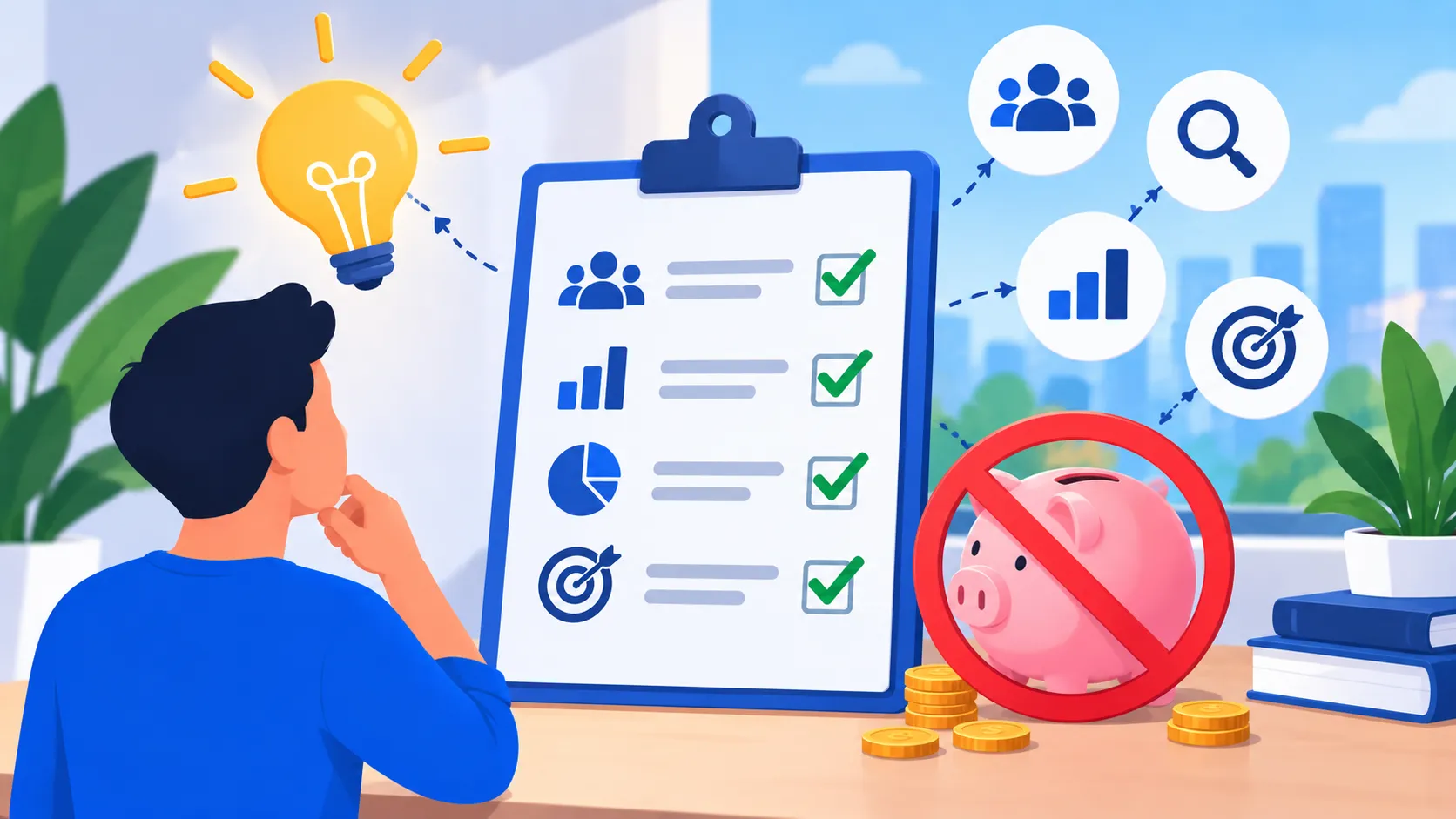
Why Research a Business Idea Before Spending Money?
Every business idea contains assumptions about customers, problems, demand, competition, pricing, distribution, and willingness to pay. Spending money before examining those assumptions turns uncertainty into financial risk. A founder may pay to build a product only to discover that customers already have a satisfactory free alternative, or spend on advertising before realizing that the target audience does not consider the problem urgent. Early research helps determine which ideas deserve investment and which should be changed, narrowed, tested differently, or abandoned.
Research Is Cheaper Than Building the Wrong Thing
The cost of learning usually increases as a business progresses. Discovering a weak assumption through public market research may cost little more than several hours. Discovering the same problem after developing software, ordering inventory, hiring employees, or signing contracts can be significantly more expensive. This is why research has disproportionate value early. It allows founders to make major changes while the business still exists primarily as a hypothesis rather than an expensive collection of commitments.
Start by Writing Down the Business Hypothesis
Before searching the market, define what you actually believe. Identify the customer you expect to serve, the problem that customer experiences, the proposed solution, the reason it should be better than current alternatives, and how the business might make money. This does not need to become a formal business plan. The purpose is to expose assumptions that can be investigated. A vague concept is difficult to disprove, while a specific hypothesis gives research something concrete to challenge.
Define the Customer as Specifically as Possible
A business targeting everyone is difficult to research because different groups behave differently. A workflow problem may be severe for an agency and insignificant for an individual freelancer. A price that feels trivial to an enterprise may be unacceptable to a small business. Narrowing the initial customer allows research to focus on relevant discussions, competitors, purchasing behavior, budgets, and acquisition channels. The target market can expand later, but early evidence becomes much clearer when the customer is specific.
Understand the Problem Before Evaluating the Solution
Founders naturally spend time thinking about what they want to build. Customers spend more time thinking about what they need to accomplish. Research should therefore begin with the problem rather than the proposed feature set. Investigate when the problem occurs, how frequently it happens, what consequences it creates, and what customers currently do about it. If the problem itself is weak, improving the solution will not necessarily create meaningful demand.
Search for Evidence That the Problem Is Real
A problem becomes more credible when customers describe it independently. Search public discussions, reviews, communities, forums, Q&A sites, industry publications, and other places where the target audience talks about its work or life. Look for specific descriptions rather than generic mentions. Someone explaining that a workflow consumes three hours every Friday provides more useful evidence than someone casually saying the process is annoying. Repeated examples across independent customers make the signal stronger.
Look for Recurring Pain Rather Than Isolated Complaints
Every product, industry, and workflow generates complaints. A single frustrated customer does not establish a market opportunity. Research becomes useful when the same problem appears repeatedly across different customers and sources. Recurring pain suggests that the issue may be structural rather than personal. Pay attention to what customers repeatedly struggle with, what they have tried, and whether the frustration causes them to search for alternatives or spend resources on workarounds.
Investigate How Customers Solve the Problem Today
Customers rarely wait for a startup to appear. If the problem matters, they are probably solving it somehow. Current alternatives might include software, spreadsheets, employees, agencies, freelancers, templates, manual workflows, or simply tolerating the inconvenience. Understanding those alternatives reveals the actual competition. Your business does not need to beat an imaginary absence of solutions; it needs to become sufficiently better than what customers already do.
Study Workarounds Carefully
A complicated workaround can be a valuable market signal because it demonstrates effort. Customers who connect several tools, maintain elaborate spreadsheets, repeatedly copy information manually, or hire someone to perform a repetitive task are already investing resources in the problem. Research why the workaround exists and what customers dislike about it. The opportunity may not be replacing the entire process. It may be simplifying one expensive or frustrating part of it.
Determine Whether Customers Already Spend Money
Existing spending is one of the most useful signals to investigate before investing your own money. Customers who pay for competing products, contractors, employees, agencies, or services have already demonstrated that the problem has economic value. This does not guarantee that they will purchase your solution, but it proves that a budget exists somewhere around the desired outcome. A market where customers consistently expect the problem to be solved for free requires a very different business model.
Research Direct Competitors
Direct competitors provide evidence about how the market currently operates. Study who they target, what they promise, how they package their products, what features they emphasize, and how they differentiate themselves. Do not research competitors merely to create a feature comparison. The more important objective is understanding why customers choose them and what would need to be true for customers to choose a new entrant instead.
Research Indirect Competitors
The most dangerous competitor may not look like your proposed business. A specialized application might compete against spreadsheets. A marketplace might compete against existing professional relationships. An automation product might compete against inexpensive labor. A new AI service might compete against a general-purpose AI assistant customers already use. Researching indirect alternatives prevents a founder from incorrectly assuming that a market is empty simply because no identical company exists.
Do Not Fear Competition Automatically
Competition often demonstrates that demand exists. If several companies successfully charge customers for solving a problem, that can be encouraging evidence. The challenge is determining whether there is room for another solution. A market becomes more interesting when competitors prove spending while customers continue to experience important unmet needs. A market becomes less attractive when existing products are excellent, customers are highly satisfied, and switching offers little additional value.
Investigate Markets With No Competition More Carefully
An idea with no obvious competitors can represent an undiscovered opportunity, but it can also indicate that customers do not care enough to pay. Search for previous attempts, substitutes, manual solutions, and evidence of people requesting something similar. If customers experience the supposed problem but consistently choose to ignore it, the absence of competitors may be a warning. An empty market is not automatically an available market.
Read Competitor Reviews
Competitor reviews can reveal what paying or active customers value after actually using a solution. Positive reviews show which outcomes matter. Negative reviews reveal unmet expectations, recurring frustrations, and reasons customers become dissatisfied. Look for patterns across many reviews rather than relying on dramatic individual examples. When similar complaints appear repeatedly, investigate whether they represent a meaningful gap or merely an unavoidable trade-off customers accept.
Look for Alternative-Seeking Behavior
Customers actively searching for alternatives provide particularly useful evidence. They already understand the category and have enough dissatisfaction to consider changing behavior. Research why they want to leave their current solution. Price increases, complexity, missing functionality, poor support, unreliable performance, or a product becoming unsuitable for a particular customer segment can all create opportunities. Repeated alternative-seeking behavior is stronger than complaints that never lead to action.
Research Competitor Pricing
Pricing pages help reveal what the market expects to pay and how competitors segment customers. Examine free tiers, trials, entry plans, premium plans, usage limits, annual discounts, transaction fees, and enterprise options. The objective is not to copy or undercut prices. It is to understand the economic environment around the problem. If customers already pay substantial amounts, a differentiated solution may have room to capture value. If every successful alternative is free, monetization deserves additional scrutiny.
Understand What Customers Are Really Buying
Customers do not buy features in isolation. They buy outcomes such as saved time, increased revenue, reduced risk, convenience, status, entertainment, simplicity, or peace of mind. Research what outcome existing customers value most. A founder may believe an automation feature is the product while customers actually care about completing a task before a deadline. Understanding the desired outcome helps determine whether the proposed business creates enough value to justify payment.
Investigate Willingness to Pay Before Setting a Budget
Before spending heavily on a business, estimate whether the customer value can support the required economics. Look at what customers already pay, what the problem costs them, and how alternatives are priced. A product that saves a business thousands of dollars may support very different pricing from one that removes a minor inconvenience. Early willingness-to-pay research can prevent founders from building businesses whose expected revenue cannot support development, service, or acquisition costs.
Do Not Ask Only What Customers Say They Would Pay
Hypothetical pricing questions can be misleading because respondents do not experience the consequences of a real purchase. Someone may say they would happily pay for a future product and behave differently when presented with a checkout page. Existing spending provides stronger evidence because the transaction has already occurred. Eventually, a real offer, deposit, preorder, or paid pilot can test willingness to pay much more reliably.
Research Buying Intent
Buying intent reveals whether customers are moving toward a purchase rather than merely discussing a problem. Search for people comparing products, asking about prices, requesting recommendations, seeking alternatives, evaluating plans, or explaining that they need a solution quickly. These behaviors demonstrate stronger commercial motivation than general interest. A smaller number of high-intent customers can represent a better opportunity than a huge audience with no intention of spending.
Separate Popularity From Commercial Demand
Popular topics attract attention that may never become revenue. Millions of people can watch videos, join communities, or discuss an issue without purchasing related products. Before investing, determine whether the attention connects to customer action. Do people spend money, search for products, request services, or dedicate meaningful resources to solving the problem? Commercial demand is more important than general popularity when evaluating whether a business can support itself.
Research Search Intent
Search engines reveal not only what people investigate but sometimes how close they are to action. Educational searches indicate interest in understanding a problem. Searches involving alternatives, reviews, comparisons, pricing, software, services, or recommendations can indicate stronger commercial intent. Search volume can be useful context, but intent matters more than raw numbers. A small group searching specifically for a paid solution may be more valuable than a large group searching for free information.
Do Not Treat Keyword Volume as a Business Model
Search volume is not revenue. High-volume keywords can attract audiences with low commercial value, while niche searches can represent valuable customers. Search data should be combined with competitor activity, pricing, customer behavior, and willingness to pay. The goal is to understand whether search demand reflects a genuine desire to solve the problem rather than simply curiosity about the topic.
Research Where Customers Spend Their Attention
A business needs a plausible path to customers. Identify the communities, search queries, marketplaces, newsletters, creators, professional groups, conferences, directories, and platforms where the target audience discovers solutions. This research helps determine whether distribution is likely to be practical. An attractive product can still struggle when customers are fragmented or prohibitively expensive to reach.
Think About Distribution Before Paying for Ads
Paid advertising can test acquisition, but it should not be the first time a founder considers distribution. Research how competitors appear to acquire customers and where buyers already demonstrate intent. A product with strong search demand may benefit from SEO or paid search. A niche B2B solution may be better suited to direct outreach or partnerships. Understanding potential channels before spending on advertising makes early tests more deliberate and easier to interpret.
Estimate the Economics Before Making Large Commitments
You do not need a sophisticated financial model at the idea stage, but basic economics deserve attention. Consider what customers might pay, how often they might pay, what the product costs to deliver, whether significant human labor is required, and what acquisition might cost. The numbers will be uncertain, but obvious mismatches can still be discovered. A business that can only charge a small amount while requiring expensive sales and service may be structurally difficult.
Research Market Gaps
A market gap is not simply a feature competitors forgot to build. Stronger gaps appear when a specific customer segment experiences recurring pain that existing solutions do not address effectively. Research can reveal products that became too complex, customer groups that competitors ignore, workflows requiring several tools, pricing models customers dislike, or important use cases handled poorly. A useful gap connects unmet need with customers who have enough motivation and budget to act.
Look for Underserved Customer Segments
Large competitors often optimize for their most profitable customers. This can leave smaller businesses, specialized industries, geographic markets, or unusual workflows underserved. Repeated comments that a product is too complex, too expensive, designed for enterprises, or unsuitable for a specific profession may indicate an opening. Before investing, verify that the underserved segment is sufficiently large, reachable, and willing to pay for a specialized alternative.
Search for Reasons the Business Could Fail
Research should challenge the idea rather than simply support it. Deliberately investigate free alternatives, satisfied competitor customers, high switching costs, failed startups, regulatory barriers, expensive acquisition, low-frequency usage, difficult operations, weak margins, and technologies that could make the proposed solution unnecessary. Negative evidence is valuable because it reveals risks while they are still inexpensive to address.
Study Failed Businesses in the Category
A failed competitor can teach you why apparent demand did not become a sustainable company. Perhaps customers liked the product but refused to pay enough. Perhaps acquisition was too expensive, retention was weak, operations were complicated, or a platform change destroyed distribution. Historical failure does not mean a new attempt must fail, but it creates questions that deserve credible answers before money is committed.
Understand Switching Costs
A better product does not guarantee customers will adopt it. Existing customers may have data, integrations, contracts, workflows, and habits tied to current solutions. Changing products can require migration, retraining, and risk. Research whether the proposed improvement is important enough to overcome those costs. If switching is difficult, identify trigger events such as contract renewals, price increases, rapid growth, or major workflow changes that make customers more receptive.
Research Timing
Some businesses become possible because the market changes. New technology can lower costs, regulation can create requirements, platforms can open distribution, and customer habits can shift. Ask why the idea makes sense now. If similar products failed previously, determine what has changed. A credible timing advantage can strengthen an opportunity, while a concept repeatedly attempted under unchanged conditions deserves more skepticism.
Use Foundly to Accelerate Business Idea Research
Manual research can involve moving between search engines, competitor websites, customer discussions, review platforms, pricing pages, marketplaces, and many individual sources before comparing what the evidence means. Foundly can help founders investigate a business idea across signals such as demand, customer pain, buying intent, competition, pricing, complaints, risks, and potential opportunities in a more focused workflow. This can be particularly useful before spending money because the objective is to expose important assumptions while changing direction remains inexpensive.
Use Foundly for Evidence, Not Permission
A research platform should not be used simply to obtain a positive verdict that makes spending feel safer. Foundly is most useful when the underlying evidence is treated as the important output. If research reveals strong competition but weak switching intent, that should influence the decision. If it reveals recurring pain, existing spending, dissatisfied customers, and an underserved segment, that deserves further testing. The conclusion should follow the evidence rather than the founder’s enthusiasm.
Compare Positive and Negative Evidence
Markets rarely produce perfectly consistent signals. Customers may complain about expensive competitors while continuing to renew subscriptions. Search interest may be strong while willingness to pay is weak. A niche may show severe pain but be difficult to reach. Research should compare these contradictions and determine which ones matter commercially. Evidence tied to actual behavior, spending, switching, and repeated pain generally deserves more weight than opinions or attention alone.
Avoid Arbitrary Validation Scores
A business opportunity cannot be understood fully through a decorative score. A seventy-eight percent validation rating says little unless the founder knows what evidence produced it. A more useful research conclusion explains what was found, where the strongest signals appear, what contradicts them, and which assumptions remain uncertain. Before spending money, context is more useful than false precision.
Talk to Potential Customers Before Building
After public research identifies a plausible opportunity, direct conversations can test whether the patterns hold among actual target customers. Ask about recent experiences rather than pitching the idea immediately. Understand how they currently solve the problem, what frustrates them, how often it occurs, what they pay, and what would motivate them to change. Customer conversations should deepen the research rather than become a search for compliments.
Ask About Past Behavior
Past behavior generally provides better evidence than hypothetical future behavior. Instead of asking whether a customer would use a new product, ask what happened the last time the problem occurred. Instead of asking what they might pay, investigate what they already spend. Instead of asking whether they would switch, ask whether they have tried alternatives before and what happened. Specific historical examples reveal priorities more accurately than predictions.
Do Not Spend on a Full Product Before Testing the Offer
Once research suggests that demand may exist, the next step does not necessarily need to be a complete product. A landing page, prototype, demo, manual service, limited pilot, preorder, or deposit can test whether customers respond to the proposed outcome. The objective is to obtain stronger evidence with the smallest reasonable investment. A founder can learn a great deal about messaging, audience, pricing, and willingness to pay before building every feature.
Create a Test That Requires Meaningful Action
A test becomes more valuable when the customer must make a real commitment. Clicking an advertisement requires little effort. Joining a waitlist requires slightly more. Booking a call requires time. Participating in a pilot requires effort and trust. Paying requires money. The closer the action resembles the behavior required by the eventual business, the stronger the validation signal becomes.
Treat a Waitlist as Early Evidence
A waitlist can be useful, especially when the subscribers closely match the target customer and arrive through realistic acquisition channels. It should not be treated as final proof. People can join without intending to buy. Follow what happens next. Do subscribers respond to messages, request access, participate in interviews, test the product, or ask about purchasing? A waitlist becomes more meaningful as users progress toward stronger commitments.
Test Pricing Before Overinvesting
Pricing can expose whether the perceived value is strong enough to support the business. When possible, present realistic offers to target customers and observe behavior. A founder who discovers early that customers will only pay a fraction of the expected price can reconsider the model before investing heavily. The goal is not to optimize pricing perfectly before launch but to verify that the economics have a plausible foundation.
Consider a Manual Version of the Service
Some software ideas can initially be delivered manually. If the proposed product analyzes data, generates reports, organizes information, matches customers, or performs another service, a founder may be able to provide the outcome manually for early users. This tests whether customers value the result before expensive automation is built. The manual process can also reveal edge cases and workflow requirements that would otherwise be discovered after development.
Use Preorders or Paid Pilots When Appropriate
Money is a stronger signal than stated interest. For suitable businesses, preorders, deposits, or paid pilots can test whether customers value the promised outcome enough to make a real commitment. These approaches require clear communication about what is being offered and when it will be delivered. They are not appropriate for every idea, but they illustrate an important principle: validation becomes stronger as the customer’s commitment becomes more costly.
Know What You Need to Learn Before Spending
Different ideas have different critical uncertainties. A marketplace may need to prove that both sides can be acquired. A hardware company may need to validate manufacturing economics. A SaaS startup may need to test willingness to pay or retention. An agency may need to prove that clients can be acquired profitably. Identify the assumption that would make the investment irrational if false, and prioritize research around it.
Test the Riskiest Assumption First
Founders often test whatever is easiest instead of whatever matters most. Designing a logo is easier than asking customers for money. Building features may be more comfortable than discovering that the audience is difficult to reach. The riskiest assumption should receive attention first because disproving it can save the most resources. Progress is not measured by how much has been built but by how much important uncertainty has been removed.
Set a Research Budget Before a Build Budget
Even when research uses paid tools, interviews, prototypes, or small advertising tests, the amount can be tiny compared with full execution. Separating a research budget from a build budget encourages founders to buy information before buying infrastructure. The first investment should help answer whether a larger investment is justified. Once the evidence improves, spending can increase proportionally.
Do Not Buy Branding Before Understanding Positioning
A polished identity cannot compensate for unclear customer value. Before investing heavily in naming, logos, packaging, or visual systems, understand who the customer is and why the product should matter to them. Research may reveal that the strongest opportunity lies with a completely different audience than originally expected. Positioning can change dramatically as evidence improves, making expensive early branding unnecessary.
Do Not Pay for Development to Avoid Market Research
Outsourcing development can make an idea feel like it is moving forward, but code does not answer whether customers want the product. Before committing to substantial development costs, gather enough evidence to justify the experiment. Technical feasibility matters, but market feasibility matters too. Building should follow the strongest available understanding of the customer rather than substitute for it.
Do Not Order Inventory Based on Enthusiasm
Physical products create additional risk because money can become trapped in inventory. Before placing large orders, investigate demand, competitor pricing, customer preferences, margins, shipping, returns, and realistic acquisition channels. Small batches, samples, prototypes, preorders, or other lower-risk tests can provide information before inventory commitments increase. The principle remains the same: make uncertainty cheaper whenever possible.
Do Not Scale Advertising Before Understanding Conversion
Advertising can generate traffic quickly, but traffic does not prove product-market fit. Early paid campaigns should be treated as experiments designed to answer specific questions about messaging, audience, acquisition cost, and conversion. Scaling spend before understanding why customers convert can hide fundamental problems behind a larger marketing budget. A strong offer should become clearer through testing before large amounts of capital are used to amplify it.
Research Legal and Regulatory Constraints
Some business ideas operate in industries where compliance, licensing, privacy, intellectual property, financial regulation, healthcare rules, employment law, or other requirements materially affect viability. These constraints should be investigated before major spending. A concept that appears technically simple may become expensive once regulatory obligations are understood. Professional legal advice may eventually be necessary, but early research can identify whether major barriers exist.
Investigate Operational Complexity
Not every difficult business problem is technological. Returns, customer support, logistics, onboarding, fraud, quality control, marketplace disputes, service delivery, and vendor management can determine whether a business works. Research how existing companies handle these operations and what customers complain about. A seemingly attractive revenue model can become much less appealing when the operational burden is understood.
Consider Customer Support Requirements
Some products require significant human support, especially when customers are nontechnical, integrations are complex, or mistakes are costly. Research competitor reviews for support-related patterns and consider how much assistance customers may expect. A low-priced product with high support requirements can create difficult economics. Understanding this before launch helps prevent a pricing model that cannot sustain the actual cost of serving users.
Evaluate Whether the Opportunity Can Grow
A small initial niche can be an excellent starting point, but founders should understand whether the opportunity supports their goals. Some businesses are attractive precisely because they can become profitable within a focused market. Others need substantial scale to justify venture investment. Research adjacent customer groups, related problems, and expansion paths without assuming they will materialize automatically. The right opportunity depends partly on the type of business the founder wants to build.
Research the Business Model, Not Just the Product
A compelling product concept can distract from questions about how the company actually earns money. Investigate whether subscriptions, transactions, services, licensing, advertising, marketplace fees, or another model fits customer behavior. Study how comparable companies monetize and where customers resist pricing. The business model should align with how often value is created and how customers prefer to buy.
Look for Evidence of Retention Potential
Before a product exists, retention cannot be measured directly, but the underlying problem can provide clues. Recurring workflows, repeated transactions, ongoing compliance needs, continuously changing data, and persistent collaboration problems naturally create reasons to return. One-time tasks may require different monetization. Research how frequently customers experience the need and whether existing solutions remain part of their routine.
Understand the Cost of Being Wrong
The amount of research required should depend partly on the consequences of a bad decision. A founder who can build a simple prototype in a weekend can tolerate more uncertainty. Someone investing savings into inventory, hiring employees, signing a lease, or entering a regulated market should demand stronger evidence. Validation should be proportional to irreversible commitment.
Know When Research Is Sufficient
Research cannot eliminate uncertainty completely. Eventually, additional reading produces diminishing returns and the next important information can only come from a real-world test. Research is sufficient when the major assumptions are understood well enough to justify the next small commitment. The goal is not to know everything about the market. It is to avoid spending large amounts while fundamental questions remain unanswered.
Know When the Evidence Says Stop
Sometimes research reveals that the business should not receive further investment. Customers may not experience enough pain, existing alternatives may be excellent, willingness to pay may be weak, distribution may be too expensive, or the economics may be structurally unattractive. Stopping at this stage can feel disappointing, but financially it may be one of the best outcomes research can produce.
Use Negative Research to Improve the Idea
Negative evidence does not always require abandoning the entire opportunity. It may reveal that a different segment has stronger demand, a narrower problem deserves attention, or a different business model fits customer behavior better. Competitor complaints may uncover a gap adjacent to the original concept. A weak idea can sometimes become a stronger one when the founder treats research as discovery rather than judgment.
How to Decide Whether the Idea Deserves Money
The decision should come from the combined evidence. A stronger opportunity usually has a specific customer, meaningful recurring pain, visible demand, existing spending, imperfect alternatives, some reason to switch, plausible pricing, reachable buyers, workable economics, and no unresolved risk large enough to destroy the business immediately. The evidence does not need to be perfect. It needs to be strong enough that the next investment is a rational experiment rather than a blind bet.
Spend in Stages as Evidence Improves
Instead of making one large commitment, increase investment as uncertainty decreases. Early spending might support research and prototypes. Stronger evidence may justify a small product test. Real usage can justify further development. Paying customers and retention can justify more aggressive acquisition. This staged approach does not remove risk, but it connects spending to learning and makes it easier to change direction when evidence changes.
Research First, Then Earn the Right to Build
Building should be the consequence of evidence rather than the default first step. A promising idea earns additional investment when customers demonstrate meaningful problems, existing behavior, buying intent, and willingness to engage with a solution. Each stage should answer a question important enough to justify the cost. Foundly can help accelerate the research stage, but customer behavior ultimately determines whether the business deserves continued investment.
Final Thoughts on Researching a Business Idea Before Spending Money
The cheapest time to discover that a business idea is wrong is before money becomes attached to it. Define the customer and problem, investigate real demand, study competitors and alternatives, examine customer complaints, understand pricing and existing spending, research distribution, identify risks, and actively search for evidence against the idea. Foundly can help organize and accelerate this evidence-driven investigation, while interviews and real-world tests can take validation further. You do not need certainty before spending anything. You need enough evidence to ensure that each new investment is buying useful learning rather than simply making an untested assumption more expensive.